


The 31st
International Biology Olympiad 2020
Sasebo City, Nagasaki, Japan
Date: July 3rd, 2020 (Fri) to July 11th, 2020 (Sat)
Venue: Nagasaki International University, Sasebo City, Nagasaki
HOME
IBO Challenge 2020 Memorial Movie
IBO2020 in Nagasaki is cancelled due to the COVID-19 global pandemic.
Instead, we are hosting a remotely-conducted competition (IBO Challenge 2020) in August-October, 2020.
Message from the IBO2020 Organizing Committee

I am very proud to announce that we are holding the IBO2020 competition in Sasebo, Nagasaki. Nagasaki is a historical and memorable place, as it is the last place that experienced an atomic bomb attack. Nagasaki is surrounded by a beautiful sea with hundreds of islands, where you can enjoy numerous marine organisms. Immersed in nature, we are sure that all the delegates will spend a wonderful time with friends from all over the world. We warmly welcome you all with some new challenges including an international group work activity. In addition, of course, you will enjoy our scientific tasks.
Looking forward to seeing you all in July 2020.
IBO2020 Sponsors
Platinum Sponsors

Gold Sponsors

Silver Sponsors

※Only silver sponsors or above are displayed on this top page.
IBO2020 Suppliers


Ryoguchiya Korekiyo
IBO Challenge 2020 Sponsor

IBO2020 Overview (Cancelled)
Official Name
The 31st International Biology Olympiad 2020 Nagasaki, Japan
Date
July 3rd, 2020 (Fri) to July 11th, 2020 (Sat) – 9 days
Venue
Nagasaki International University, Sasebo City, Nagasaki
Awards
After evaluating both practical and theoretical exams, students within approximately the top 10% scores will receive gold medals; the next 20% and 30% will respectively receive silver and bronze medals.
Secretariat
Secretariat of the 31st International Biology Olympiad 2020 Nagasaki, Japan
Kagurazaka 3-1, Shinjuku City, Tokyo 162-8601 JAPAN
Phone: 03-5228-8286
Email: ibo2020@jsf.or.jp
Please use the address below for general inquiries and mailing:
Tokyo University of Science Building No.1, 13th floor,
Kagurazaka 1-3, Shinjuku, Tokyo 162-8601
Phone: 03-5228-8286
Japonica Species Guide
Introducing species with "japonica" in their names!
Hover your cursor to read the description.
If you reload the browser, new species will appear!

Prasiola japonica
No.19 Kawanori
Prasiola japonica is a species of freshwater seaweed called “Kawanori” in Japan. In Japanese, this name literally translates to “river seaweed.” It is bright green in color and grows up to 20 cm long and 4 cm wide. Found in Japan and China, it grows in rapid mountain streams attached to rocks. In Japan, it has historically been pressed, dried, and sold as food to be eaten broiled or pickled.
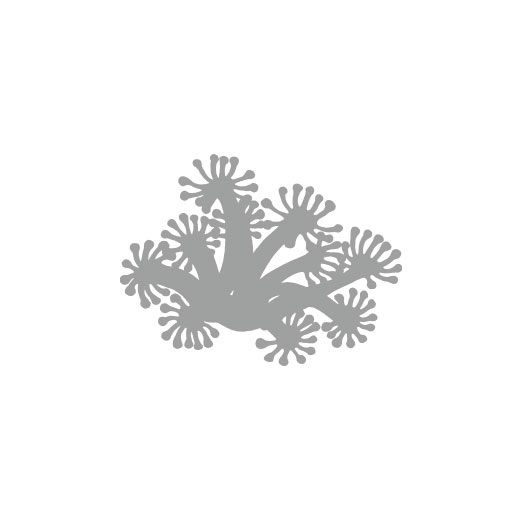
Alveopora japonica
No.31 Type of Scleractinian Coral
Alveopora japonica is species of colonial Scleractinian coral, an order known for their “stony” calcium carbonate skeletons. The polyps of this species are dark green and have twelve white-tipped tentacles. Each colony is less than 10 cm across and appears in an encrusting or hemispherical growth-form. Found along shallow rocky foreshores in Taiwan, Japan, and Korea, Alveopora japonica is one of the most dominant type of Scleractinia in the region. Recently, Alveopora japonica populations have been increasing along the southern coast of Korea as local kelp forests have been declining, a dynamic that may be influenced by rising sea temperatures.
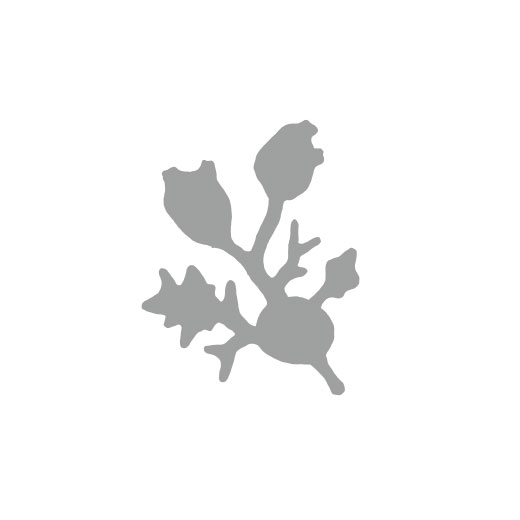
Perophora japonica
No.36 Type of Colonial Sea Squirt
Perophora japonica is a species of marine invertebrate called a tunicate or “sea squirt.” Colonial in nature, this species consists of round, 4-6 mm long, yellowish-green zooids growing together along a branch-like structure called a stolon, which grows from a barrel-like body called a tunic. At the stolon’s end are yellow star-shaped zooids that can form their own colonies when dislodged. While native to Japan, Korea, and Russia, it has spread to the coasts of the UK, France, the Netherlands, Spain, West Africa, and the west coast of North America, possibly in the hulls of commercial and recreational ships.
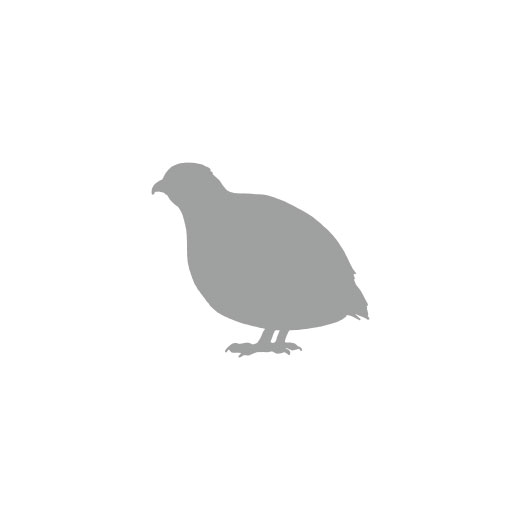
Coturnix japonica
No.11 Japanese Quail
Coturnix japonica is a economically and scientifically important quail that resides in East Asia. These quail have cinnamon-brown plumage and are relatively small in size, with wild adults reaching weights of about 100 grams. While they regularly inhabit Japan, Korea, China, India, and Russia, they have been known to migrate to southeast Asia, the northwest coast of Africa, and sub-Saharan Africa. Japanese quail are used worldwide as meat and egg-producing agricultural animals. In addition, its fully sequenced genome, quick maturation, small size, and developmental patterns make Coturnix japonica a model lab animal in genetics, immunology, developmental biology, and endocrinology studies.